Clothing and Accessories · Fabric Guide
Linen Aprons Under the Microscope: How Weave and Fiber Shape Everyday Use
A linen apron is more than a layer between a cook and a splatter. Its feel and performance emerge from a chain of material choices: the flax fiber, the way yarns cross, the weight of the cloth, and the finish applied after weaving. Understanding those details makes it easier to choose an apron that suits the rhythm of a real kitchen.
Published October 9, 2026
Linen begins in a field, not at a loom. The fabric is made from flax, a plant cultivated for thousands of years across temperate regions. Once the flax stems are harvested and processed, their fibers can be spun into yarn and woven into cloth. That plant-to-fabric journey helps explain linen’s distinctive character: it can feel cool and textured, soften through use, and remain durable when properly cared for.
But “linen” is not a complete performance description. Two aprons made from linen may feel quite different on the body. One might be airy and fluid; another, dense and protective. A crisp new fabric can become more relaxed after washing, while a blend may add a degree of resilience or change the hand feel. Weave, yarn, weight, finishing, and construction all contribute to what happens when the apron is worn through a long meal preparation or a day of kitchen work.
Reading those clues is a practical form of material literacy. Rather than judging an apron by fiber content alone, consider how the cloth is built and finished—and whether those qualities match the tasks it will face.
From flax fiber to apron cloth
Flax fibers are naturally strong and have a characteristic irregularity that can show up as subtle slubs, or small variations in the yarn. Those variations are not necessarily flaws. They are part of the visual and tactile language of linen, giving the surface a less uniform appearance than many smooth, tightly controlled fabrics.
How the fibers are prepared and spun matters. Yarn thickness and consistency influence the texture of the finished fabric, while the way yarns are arranged at the loom determines the weave. The broad term “linen” therefore describes a family of fabrics, not one fixed texture or weight.
In daily use, the most noticeable qualities are often straightforward: how much the apron breathes, how it hangs, whether it feels crisp or soft, and how it responds to washing. Linen is commonly appreciated for airflow and a dry, textured hand. It also creases readily. That tendency is part of its character, though people who prefer a sharply pressed appearance may find it requires more attention than a smooth, wrinkle-resistant textile.
Weave: the quiet architecture of fabric
Weave describes the pattern in which lengthwise yarns, called warp, interlace with crosswise yarns, called weft. The structure affects a fabric’s surface, flexibility, density, and drape. A product description may name a weave, or it may simply identify the material and finish. When weave information is available, it can offer useful context—but it should be considered alongside weight and construction rather than as a guarantee of performance.
Plain weave and everyday balance
In a plain weave, each weft yarn passes over and under alternating warp yarns. This straightforward structure is widely used because it can produce stable cloth with a balanced appearance. Depending on the yarn and density, plain-woven linen may feel light and open or more substantial and closely set. The weave name alone does not tell you the fabric’s exact weight or softness.
Twill weave and diagonal texture
Twill is recognized by its diagonal pattern, created as the interlacing point shifts from one row to the next. The resulting surface can feel distinctive under the hand, and the structure may produce cloth with a supple drape. Yarn choice and weave density still make a difference, so “twill” should be read as a description of construction—not a promise that every twill apron will feel the same.
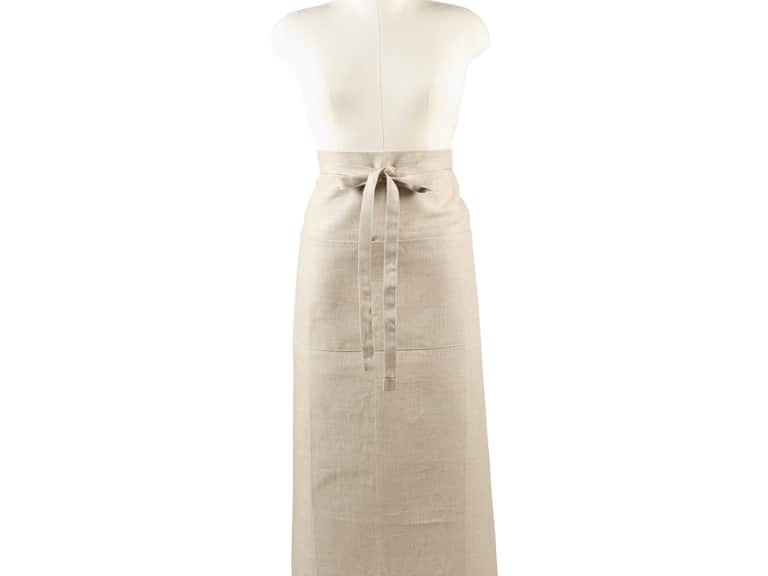
The Café Apron is described as 100 percent linen, with a Belgian Linen label and a roomy front pocket. Its product details do not specify a particular weave, so a shopper should not assume one. It offers a useful example of the distinction between what a listing confirms—fiber content, pocket, and ties—and what it leaves unstated.
By contrast, the Cuoco Apron is described as yarn-dyed twill. Yarn-dyeing means the yarn is colored before the cloth is woven, a process that can create color throughout the woven structure rather than applying it only after the fabric has been made. The apron is made from 100 percent linen and slips over the head without ties or hardware. Its construction details help describe how it is worn, while the twill description points to the fabric’s weave.
Fabric weight: a clue, not a verdict
Fabric weight is commonly expressed as mass per area, using units such as grams per square metre or ounces per square yard. In general, a heavier fabric contains more material per given area than a lighter one. That can influence coverage, drape, and how substantial the apron feels. It does not automatically mean the apron is more durable, more comfortable, or better suited to every task.
A lighter linen may feel less cumbersome during warm-weather cooking or extended wear. A heavier cloth may offer a more grounded drape and a reassuring sense of coverage. But weight interacts with weave and finishing. A compact, tightly woven lighter fabric can feel different from a more open fabric of similar weight, and garment washing can change the hand without changing the fiber identity.
Weight is only one piece of the decision. Apron cut, coverage, straps, pocket placement, and fit all influence comfort. A fabric that feels pleasant in isolation may still be inconvenient if the ties pull, the neck strap sits poorly, or the pockets do not suit the way someone works.
Finishing changes the first impression
After weaving, fabric may be washed, softened, dyed, or otherwise finished. These treatments influence the surface and the way cloth behaves when it first reaches the wearer. “Garment washed,” for example, indicates that the completed garment has been washed as part of its finishing. The process can give fabric a softer, more lived-in feel than an untouched, crisp surface.
The Harbour Apron is garment washed and made from 91 percent linen and 9 percent polyamide. It has a large front pocket with ties at the neck and waist. The product description says the washing is intended to enhance hand feel and durability; the blend is presented as a balance of linen’s breathability with dependable wear. A small share of another fiber can alter the behavior of a cloth, but the exact result depends on the fiber, yarn, weave, and finishing together.
Finishing is not the same as a permanent shield against wear or stains. A softer feel does not mean a garment needs no care, and a particular finish does not eliminate the effects of friction, heat, spills, or repeated laundering. Product care instructions remain important, especially for natural fibers and any components that may respond differently to washing.
What linen feels like in a working kitchen
Kitchen work is a sequence of changing conditions: warmth near the stove, cooler air at the counter, movement between sink and table, and occasional contact with water, flour, oil, or food. An apron is close to the body through all of it. Breathability and drape therefore matter alongside toughness.
Linen’s textured surface and airflow can make it comfortable for routine tasks, while its tendency to crease is visible in everyday wear. It is not a substitute for specialized protective clothing where serious heat, sharp tools, or hazardous substances are involved. Nor should a fabric’s natural origin be taken to mean it is automatically stain-proof or maintenance-free.
Construction also affects the experience. A cross-body design distributes support differently from a neck strap. Waist ties allow adjustment, while a slip-over design avoids hardware and tying. A large front pocket can hold frequently used small items, but pocket capacity and placement should suit the wearer’s habits. These details may have as much influence on daily usefulness as the fiber itself.
How to compare linen apron descriptions
Product listings often combine material claims with design details. Separating those details helps avoid assumptions. Start with the fiber content, then look for weave, weight, finishing, and care directions. Finally, evaluate the construction and fit.
- Fiber content: Check whether the garment is 100 percent linen or a blend. If blended, note the other fiber and its stated proportion.
- Weave: Look for terms such as plain weave or twill. If no weave is named, treat it as unspecified rather than guessing from appearance.
- Weight: When a measurement is provided, use it as a comparison point, not a stand-alone quality score.
- Finish: Terms such as garment washed or stonewashed describe treatment that can influence softness and surface character.
- Construction: Consider straps, ties, pockets, coverage, and how the apron is put on and adjusted.
- Care: Follow the specific washing and drying guidance. Avoid assuming that all linen garments have identical care requirements.
Provenance language also deserves careful reading. A label or origin statement may refer to where a fabric was woven, where fibers were sourced, or where a garment was assembled. These are different stages of production. For example, the Café Apron’s description associates its Belgian Linen label with linen woven in Belgium from European flax yarn. That is more specific than simply saying “European linen,” but it still describes particular parts of the supply chain rather than every stage of manufacture.
Care through repeated washing
Aprons are made to be used, and their care routine should fit the material and the maker’s instructions. Washing can remove soil and cooking residues, while repeated cycles may change a fabric’s softness, texture, and appearance. Temperature, detergent, agitation, drying method, and whether the garment is left damp or allowed to dry fully can all influence the outcome.
Check the care label before washing, particularly when an apron includes blended fibers, coatings, or separately treated components. The Cuoco Apron’s listed instructions, for example, call for a warm machine wash, no bleach or fabric softener, no wringing, and line drying or medium tumble drying. Because its accompanying bag is wax-coated, the bag’s care needs should be considered separately from the linen garment. Specific directions matter more than broad assumptions about what linen can tolerate.
For routine care, empty pockets first and deal with spills as soon as practical. Avoid harsh treatment unless the care guidance permits it. If a garment is ironed, use the temperature and moisture approach recommended for that fabric. Some wearers prefer linen’s relaxed creases; others may choose to press it. Neither approach changes the underlying weave, but it does change the apron’s appearance.
Choose for the work, not just the label
The best linen apron is not necessarily the heaviest, the softest, or the one with the most technical description. It is the one whose material and construction make sense for the wearer’s routine. Someone who cooks for long stretches may prioritize comfortable straps and an easy-care finish. A person who moves between kitchen and garden may value coverage, durable ties, and a practical pocket. Someone who prefers uncomplicated dressing may favor a pull-on design.
Comparing the Café, Cuoco, and Harbour aprons illustrates how different details answer different questions. The Café listing specifies 100 percent linen, a roomy pocket, and ties that can be secured at the front or back. The Cuoco listing adds a yarn-dyed twill description and a slip-over design. The Harbour combines linen with polyamide and identifies garment washing, a large pocket, and neck and waist ties. Each description provides a distinct set of clues; none should be treated as a universal definition of linen performance.
In the end, fabric is a small landscape of decisions. Flax becomes fiber, fiber becomes yarn, yarn crosses into cloth, and cloth is shaped into something that moves with a body. A weave can give the surface a quiet diagonal; washing can soften its first touch; a pocket can make a familiar task easier. Looking closely at these details turns a simple apron choice into a clearer understanding of what materials do—and why the same word, linen, can describe fabrics with markedly different everyday lives.
Quick reference: linen apron terms
- Flax fiber
- The plant-based fiber used to make linen yarn.
- Weave
- The structure formed by interlacing warp and weft yarns.
- Twill
- A weave structure that typically creates a diagonal surface pattern.
- Fabric weight
- A measure of mass over a defined area, useful for comparison but not a complete measure of quality.
- Garment washed
- A finishing description indicating that the completed garment has been washed.